Sceye HAPS Specs Payload, Endurance, And Breakthroughs In Battery Technology
1. Specifications explain what an actual platform can do
There's a tendency within the HAPS industry to focus on ambitions rather than engineering. Press releases discuss coverage areas as well as partnership agreements and commercial timeframes, but the deeper and more interesting discussion is about specifications, what the vehicle actually holds as well as how long it can be kept up, and what energy systems are required to make a sustained operation feasible. Anyone who wants to know whether a platform that is stratospheric is genuinely mission-capable and not on the verge of being a promising prototype performance of the payload, endurance measurements and battery performance are where the actual substance lives. The vague promises of "long endurance" and "significant payload" are a given. Delivering both simultaneously while at a higher altitude is the engineering challenge which differentiates credible announcements from bold statements.
2. The Lighter Than Air Architecture Alters the Payload Equation
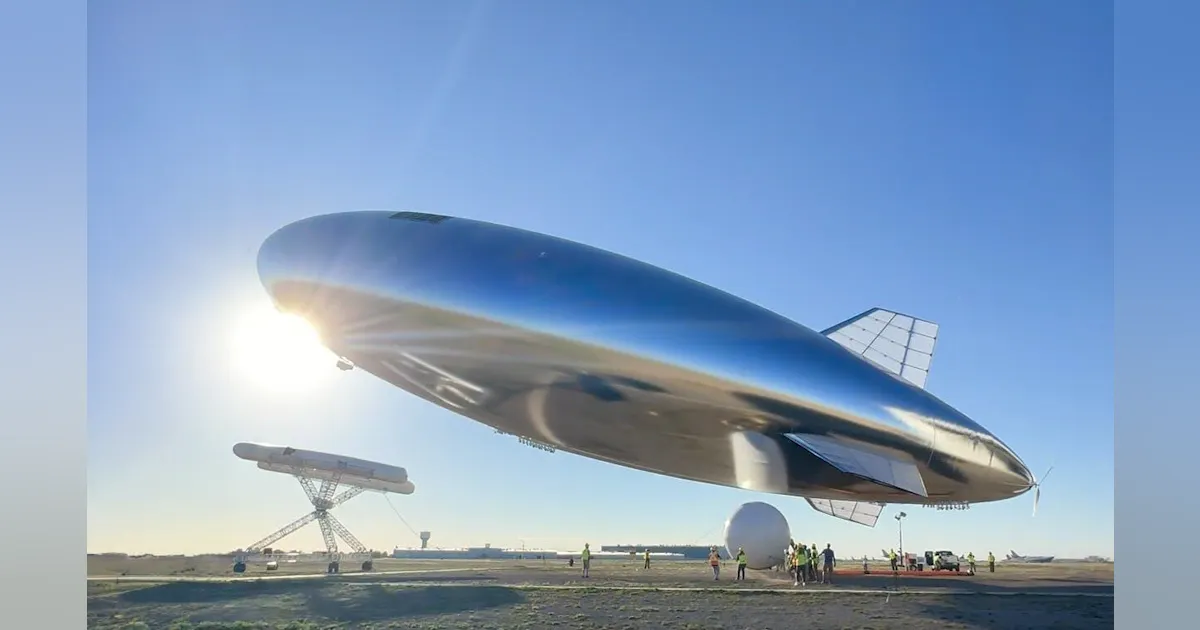
The principal reason that Sceye's Airship design can carry meaningful payload is buoyancy carries out the main task that keeps the vehicle moving. This is not an insignificant difference. Fixed-wing solar airplanes generate aerodynamic lift indefinitely. This is energy-intensive and can impose structural constraints which limit the extra weight the vehicle can carry. A ship floating at equilibrium in the stratosphere won't expend energy fighting gravity the same manner- meaning that the power produced by the solar array and the structural strength of the vehicle itself, may be directed to stations keeping, propulsion and payload operation. This results in a payload capability that fixed-wing HAPS designs with comparable durations really struggle to match.
3. Payload Capacity determinant mission scalability
The true significance of higher capacity payloads becomes evident once you consider what soaring needs missions really require. A telecommunications payload – antenna systems and signal processing hardware beamforming equipment — carries real weight and volume. So does a greenhouse gas monitoring suite. And so does a wildfire identification as well as an earth observation. For each of these missions properly requires equipment that is large. A multi-mission system requires more. Sceye's airship requirements are formulated on the basis that a spacecraft should be able to carry a genuinely practical combination of payloads than making operators choose between observation and connectivity, since the vehicle isn't able to accommodate both at once.
4. Endurance is Where Stratospheric Missions win or lose
A platform that can reach stratospheric levels for up to about 48 hours prior to having to make a descent is useful for demonstrating. A platform that can remain in place for weeks or months at one time is helpful for construction of commercial services. The difference between those two options is essentially related to energy — specifically, whether the vehicle is able to produce enough solar power in daylight to operate all devices and recharge its batteries sufficiently to maintain fully functioning through the night. Sceye endurance targets are based around this challenge during the day making sure that overnight energy is considered not as a stretch objective instead as a specifications that everything else should be designed around.
5. Lithium-Sulfur Battery Represents a Genuine Step Change
The battery chemistry behind conventional consumer electronics and electric vehicles, particularly lithium-ion possesses density characteristics that lead to real limitations for stratospheric endurance applications. Every kilogram of battery mass that is carried around is a kilo of energy not available to be used for payloads, but you'll require enough stored energy to keep a big platform running through a tense night. The chemistry that makes lithium-sulfur work changes this significantly. With energy density values that reach 425 Wh/kg, lithium-sulfur batteries can store significantly more energy per unit of mass than similar lithium-ion battery. If you're driving a car with a limited weight, and every kilogram of battery mass is an opportunity cost in payload capacity gain in energy density will not be significant, but it is architecturally significant.
6. New advances in the efficiency of solar cells are the Other Half of the Energy Story
The battery's energy density determines how much power you have the capacity to store. The efficiency of solar cells defines how quickly you will be able to replenish it. Both matter and progress within one without improvement in the other causes a distorting energy architecture. The advancements in high-efficiency photovoltaic cells with multi-junction design that take in a wider spectrum of solar energy than standard silicon cells — have meaningfully improved the amount of energy gathered by HAPS powered solar vehicles during daylight hours. Combined with lithium-sulfur storage, this technology makes the concept of a closed power loop achievable: generating and storing enough energy daily for all devices to operate indefinitely without the need for external energy.
7. Station Keeping draws continuously from the Energy Budget
It's common to think of endurance solely as being in the air, but for an ozone-based platform, being on the ground is just a part of the energy equation. Station keeping — holding position against the winds of the stratosphere via continuous propulsion draws power constantly and represents a significant fraction of total energy usage. The budget for energy has to keep station keeping with payload operation, avionics communications, and thermal management systems simultaneously. That's why the specifications that state endurance, but don't specify the system that is operating within that time frame are difficult to measure. The true endurance figures are based on full operation, not a unconfigured vehicle coasting payloads shut off.
8. The Diurnal Cycle Is the Constraint on Design that Everything else Is Flowing From
Stratospheric engineers talk about the diurnal phase — the rhythmic daily cycle of availability of solar energyas the main element around which platform design is designed. At daytime the solar array must produce enough power to power all the systems and recharge the batteries at a sufficient rate. At night, those batteries must be able to last up to sunrise without being moved, affecting the performance of the payload, or entering any kind of reduced-capability mode which could disrupt a continuously monitoring or connectivity mission. Constructing a vehicle that can move this needle without fail daily, for a long period of time is the primary engineering challenge for solar-powered HAPS development. Every single specification choice including solar array size and battery chemistry, propulsion efficiency, power draw for the payload — feeds into this single controlling constraint.
9. It is the New Mexico Development Environment Suits This Kind of Engineering
Making and testing a soaring airship requires infrastructure, airspace, and atmospheric conditions which aren't all available. Sceye's base in New Mexico provides high-altitude launch and recovery capabilities, clean clouds for solar-powered testing along with access to type of continuous, uninterrupted airspace that prolonged flight testing calls for. Within the field of aerospace companies in New Mexico, Sceye occupies an exceptional position, focused on stratospheric lighter-than-air devices rather than the traditional rocket launch plans related to the state. The engineering rigor required for the validation of endurance claims as well as battery performance under real stratospheric conditions is precisely the type of work that would benefit of a test area that is specifically designed for testing as opposed to sporadic flights elsewhere.
10. Standards that stand up under Examination Are What Commercial Partners have to know.
In the end, one of the reasons the specifications are crucial, besides technical reasons, is that partners from the commercial sector making investment decisions must be aware that the numbers are accurate. SoftBank's promise to build a nationwide HAPS system in Japan with a focus on pre-commercial services in 2026, is predicated on the confidence that Sceye's technology can operate as planned in operating conditions and not just during controlled tests, but sustained over the mission durations commercial networks require. Payload capacity that holds up with a complete telecommunications and observation suites on board endurance measurements that are validated through actual operations in the stratosphere, and battery endurance demonstrated in real daylight cycles are the key to turning an aerospace initiative that has potential into the infrastructure a major telecoms operator is prepared to stake its network plans on. See the most popular sceye services for more advice including sceye haps status 2025 2026, 5G backhaul solutions, sceye haps softbank partnership details, Diurnal flight explained, what is haps, Sustainable aerospace innovation, HAPS investment news, sceye haps softbank japan 2026, softbank satellite communication investment, Stratospheric telecom antenna and more.
Mikkel Vestergaard's Vision Behind Sceye's Aerospace Mission
1. It's a largely under-rated Factor when it comes to Aerospace Company Outcomes
The aerospace business produces two broad types of company. The first is built around the search for applications of technology and an engineering capacity seeking a market. The second takes a issue that's significant and moves towards the technology needed to tackle the issue. The distinction is abstract when you think about what each type of business actually creates with its partners, the kinds of partnerships they pursue and the way it decisions when resources are limited. Sceye belongs in the second category, and having a clear understanding of the orientation is crucial to fully comprehending the reasons why the organization has made the unique design choices it has made -light-than-air design, multi-mission payloads that emphasize endurance and a founding home in New Mexico rather than the areas of aerospace clusters along the coast that attract the majority of space-related venture capitalists.
2. The Problem Vestergaard Took On Was Much Bigger than Connectivity
Most HAPS companies find their main stories in telecommunications. it's connectivity gap the lost billions, the business of connecting remote communities without connectivity to the internet. These are real and important problems, but they are commercial in nature and require commercial solutions. Mikkel Vestergaard's starting point was different. His experience in applying cutting-edge technologies to the environmental and humanitarian challenges produced a founding orientation at Sceye that views connectivity as one of the outputs of stratospheric infrastructure rather than as the primary reason for its existence. Greenhouse gas monitoring the detection of natural disasters, earth observation and monitoring of oil pollution and management of natural resources were all part of the mission's architectural framework from early on, but not items added later in order to make a telecoms platform look more socially conscious.
3. The Multi-Mission Platform Is a Direct Expression of That Vision
When you realize that initial question was about how the to use the stratospheric network to address critical monitor and connectivity problems at the same time, the multipayload platform looks less like a clever commercial strategy and becomes like the obvious answer to that question. Platforms that carry communications hardware, methane monitoring sensors as well as technology for detecting wildfires isn't trying make itself available to everyone and is expressing the idea that issues worth addressing from the stratosphere are interconnected, and a vehicle that is capable of tackling a range of them simultaneously is more in line to the overall goal than a system optimized for one revenue stream.
4. New Mexico Was a Deliberate Decision, not an impulsive One
The location of Sceye's within New Mexico reflects practical engineering demands- airspace access or atmospheric testing conditions capability to climb altitudes — but it also tells a story regarding the company's brand identity. The well-established aerospace clusters of California and Texas attract companies whose primary clients are investors, defense contractors, and the media industry that surrounds them. New Mexico offers something different in the form of the physical surroundings needed for the actual task of designing and testing stratospheric lighter-than air platforms without the pressure of being in close proximity to those that write and invest in aerospace. Among aerospace companies situated in New Mexico, Sceye has built a development programme oriented towards engineering validation instead of public narrative, a decision that shows a founder who is who is more concerned about how the platform works than in whether it generates stunning announcement cycles.
5. The design priority of endurance The design reflects a long-term mission orientation
Short-endurance HAPS platforms are interesting examples. Long-endurance structures are infrastructure. The importance placed the importance of Sceye longevity — creating vehicles that will be able to maintain station over months or for weeks instead of days illustrates a founder's knowledge of the difficulties that need to be addressed in the stratosphere do not resolve itself between flight campaigns. Greenhouse gas monitoring that operates for a week, and then goes dark, produces a recording with no scientific or regulatory significance. Disaster detection that requires a platform that must be relocated and restarted after every deployment does not provide the continuous early warning layer that emergency management professionals need. The endurance specification is an assertion of what a actual mission requires but is not a measure of performance designed for its own purpose.
6. The Humanitarian Lens Shapes Which Partnerships Preferentially Feature
Not every potential partnership is worthwhile or pursuing, and the criteria an organization uses to assess potential collaborators tells you something fundamental about its goals. Sceye's alliance with SoftBank to operate Japan's nationally-recognized HAPS network — which will provide pre-commercial services starting in 2026is noteworthy not only due to its commercial scope, but because of its connection to the nation that needs the capabilities that the stratospheric network provides. Japan's seismic sensitivity, complicated geography, and national dedication to monitoring environmental conditions make it a location in which the platform's multi-mission capabilities serve actual needs, not just making money in a marketplace with a wide range of options. This alignment between commercial partnerships and mission objectives isn't in any way accidental.
7. The investment in Future Technologies Requires Conviction About the Problem
Sceye is a startup company operating in a developing environment in which the technologies it relies on including lithium-sulfur batteries of 425 Wh/kg energy density high-efficiency solar cells designed for stratospheric aircraft, advanced beamforming techniques for stratospheric communications antennas — are near the limits of what's feasible today. Business plans based on technologies that are improving but not yet fully mature requires a founding team with an accurate understanding of the significance of the issue to justify the risk to the timeline. Vestergaard's conviction that the stratospheric layer will become a permanent layer of global monitoring and connectivity architecture is what keeps investors investing in technologies to come that aren't likely to attain their full potential until the technology they allow is in operation commercially.
8. The Environmental Monitoring Mission Has Become more urgent since it was established
One of the features of starting a company based on an actual issue rather than a current technology trend is that the problem tends to become more than less significant over time. When Sceye was created, the case for continued stratospheric greenhouse gas monitoring in wildfire detection and warnings of climate disasters was convincing in principle. In the intervening years there has been an increase in the number of wildfires, the increasing scrutiny of methane emissions under international climate frameworks, and the inadequacy demonstrated by existing monitoring infrastructure have all strengthened the case of Sceye considerably. The vision of the founding document hasn't had change to remain useful, as the world has moved toward it.
9. Sceye's Careers Sceye Reflect The Breadth of the Mission
The range of disciplines required in the construction and operation of stratospheric platforms with multi-mission capabilities is wider than most aerospace programs need. Sceye careers span meteorology, materials engineering technology for power systems, telecommunications remotely sensing software design, and regulatory affairs – one of the many disciplines that reflect an array of capabilities that the platform is designed to accomplish. Businesses based around a single-use technology tend to employ only within the area of expertise that this technology is based on. The companies are based on a need that requires multiple technologies to help fill the boundaries of those disciplines. The persona of the talent Sceye offers and develops is a reflection the scope of the original vision.
10. The Vision Is Effective because It's Specific about the Issue It's not about the solution.
The most durable founding visions of technology companies are both specific about the problems they're solving and adaptable about the means. Vestergaard's frame — permanent stratospheric infrastructure that monitors, connectivity, as well as environmental observation — is specific enough to create clear engineering requirements and clear partner criteria as well as being flexible enough allow for the development of technology that will enable. As the chemistry of batteries improves, when solar cell efficiency rises and as HIBS standards get more advanced, and as the regulatory environment that governs stratospheric operations is created, Sceye's mission remains the same and its methods for executing that mission may incorporate latest technology at every stage. That structure, fixed on the problem but flexible on the solution — is the reason why the aerospace mission has consistency across a timeframe of development measured in years rather than manufacturing cycles. Take a look at the top softbank group satellite communication investments for website tips including what does haps stand for, sceye haps airship status 2025 2026, aerospace companies in new mexico, sceye haps project updates, Stratospheric broadband, sceye haps softbank partnership, sceye haps softbank partnership, HAPS investment news, Diurnal flight explained, 5G backhaul solutions and more.
